
Can you list the empires that were established in the world throughout history in chronological order?
While it’s difficult to fit all the thousands of states and empires established throughout history into a single list, we can chronologically rank the most important empires that shaped world history, ruled vast territories, and left deep marks:
Ancient Times (3000 BC – 500 AD)
Akkadian Empire (2334 BC – 2154 BC): Founded in Mesopotamia, it is considered the first known empire in history. Under the leadership of King Sargon, it united the city-states under one banner.
Assyrian Empire (Neo-Assyrian: 911 BC – 609 BC): A ruthless but organized empire encompassing Mesopotamia, the Levant, and Egypt, known for its military technology (iron weapons and chariots) and its regular army.
Achaemenid (Persian) Empire (550 BC – 330 BC): Founded by Cyrus the Great, it was the first superpower in history, ruling over a vast portion of the then-known world (from the Balkans to India). It was governed by a system of provinces called “satrapies.”
Macedonian (Alexander the Great) Empire (336 BC – 323 BC): A short-lived but vast empire, established by Alexander the Great after the destruction of the Persian Empire, stretching from Greece to India and initiating the Hellenistic Period where Eastern and Western cultures merged.
Mauritanian Empire (322 BC – 185 BC): The first major Indian empire to unite almost the entire Indian subcontinent under a single rule. It is particularly known for the reign of King Ashoka and the spread of Buddhism.
Chinese Empire (221 BC – 220 AD): Founded during the period when Qin Shi Huang united all the Chinese kingdoms and initiated the Great Wall of China, and solidified by reviving the Silk Road trade under the Han Dynasty.
Roman Empire (27 BC – 395/1453 AD): The empire that transformed the Mediterranean into a “Roman Lake,” laying the foundations of modern Western civilization in law, architecture, state administration, and language (Latin). It was divided into East and West in 395.
Middle Ages (500 – 1500 AD)
Byzantine (Eastern Roman) Empire (395 – 1453): The eastern half of Rome, surviving for another thousand years, with its capital in Constantinople (Istanbul), one of the greatest centers of the Christian world and culture.
Göktürk Khaganate (552–745): A vast nomadic empire stretching from Central Asia to the Black Sea, the first in history to officially use the name “Turk” as a state name.
Umayyad and Abbasid Caliphates (661–1258): Enormous geographical empires that, with the spread of Islam, stretched from Spain to the borders of India, experiencing a golden age of science and philosophy (the Golden Age of Islam), particularly centered in Baghdad during the Abbasid period.
Holy Roman Empire (962–1806): Founded on the legacy of Charlemagne, a loosely federative empire in Central Europe (especially Germany and its surroundings), consisting of hundreds of small principalities and constantly engaged in power struggles with the papacy.
Mongol Empire (1206–1368): Founded by Genghis Khan, the largest contiguous empire in world history. It stretched from the Pacific Ocean to Eastern Europe. After his death, the Golden Horde was divided into four dynasties: the Ilkhanate, the Chagatai, and the Yuan Dynasty.
Inca and Aztec Empires (1300s – 1521/1532): The most advanced civilizations of the pre-Columbian Americas, revolutionizing engineering and architecture, but destroyed by the arrival of the Spanish Conquistadors.
Modern and Early Modern Periods (1500 – 1922)
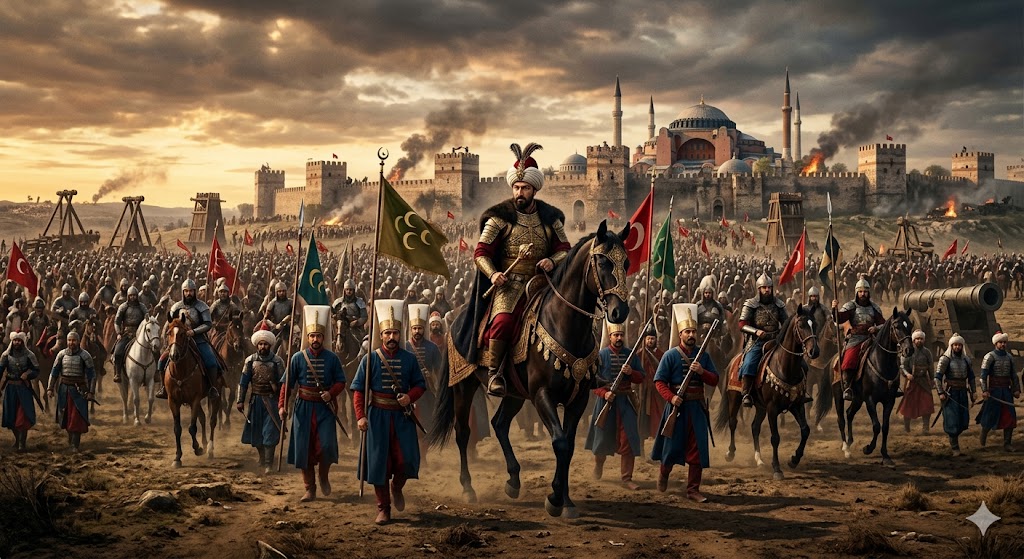
Ottoman Empire (1299 – 1922): A world empire that spanned three continents (Europe, Asia, Africa), controlled the Mediterranean and Silk/Spice routes, assumed the caliphate of the Islamic world, and survived for over 600 years.
Mughal Empire (1526 – 1857): Founded in India by Babur Shah, of Chagatai Turkic origin, an empire renowned for its wealth, reaching its peak in architecture (such as the Taj Mahal), and art.
The Spanish Empire (1492–1976): A global power that colonized the Americas through geographical discoveries, extended as far as the Philippines, and is known in history as the “first empire on which the sun never set.”
The Russian Empire (1721–1917): Under the leadership of Peter the Great (Peter I), it transformed from a tsardom to an empire, one of the largest states in the world, with territories stretching from the Baltic Sea to the Pacific Ocean, and even to Alaska at one time.
The British Empire (16th Century–20th Century): Thanks to the Industrial Revolution and its powerful navy, it ruled over nearly a quarter of the world’s land and population, the largest global empire history has ever seen (the second “empire on which the sun never set”).
This chronology clearly shows how humanity, starting from tribes and city-states, built massive global governance structures, and how the balance of power shifted over time from East to West, from the Mediterranean to the oceans.
About the Author


