Çankırı'da gezilmesi gereken ilk 10 yer?
What are the top 10 places to visit in Çankırı?
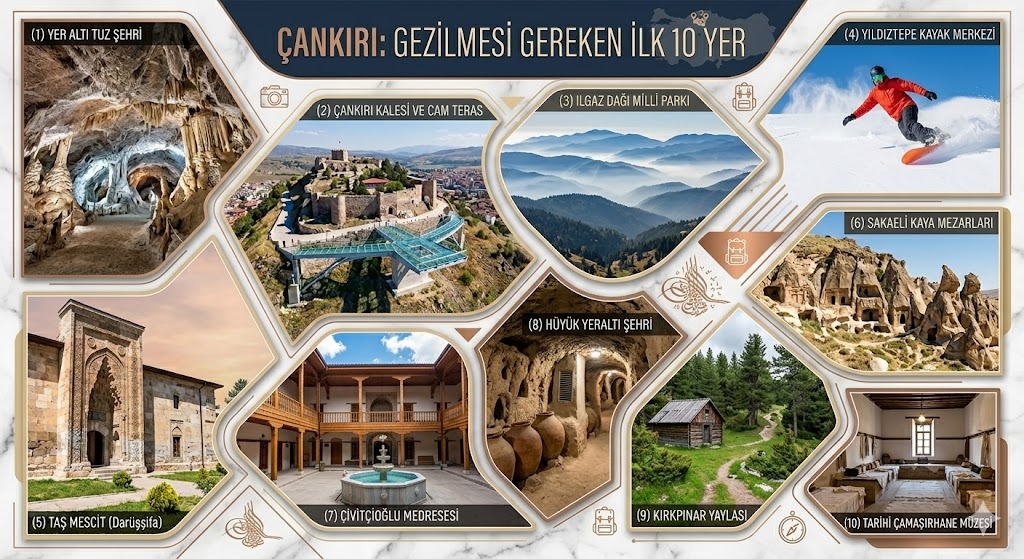
1. Underground Salt City (Salt Cave)
One of the first places that comes to mind when Çankırı is mentioned, this cave is one of Türkiye’s largest rock salt reserves, operated for approximately 5,000 years. Located about 19 km from the city center, the interior of the cave resembles a gigantic underground city. Besides sculptures made of salt by artists, interesting details such as a dead donkey preserved for hundreds of years thanks to the cave’s dry air attract great interest from visitors.
2. Çankırı Castle and Glass Observation Terrace
Although only remnants of the walls remain of the historical castle located on a small hill north of the city, it now serves as a picnic area and a panoramic viewpoint overlooking the city. Inside the castle is the tomb of Emir Karatekin Bey, known as the “Conqueror of Çankırı.” Additionally, the Glass Observation Terrace, built at the highest point of the castle, offers visitors a thrilling and enjoyable panoramic view of Çankırı.
3. Ilgaz Mountain National Park
Located on the border of Çankırı and Kastamonu, Ilgaz Mountain is the most important center in the region for both winter tourism and nature sports. Covered with fir, Scots pine, and black pine forests, the national park welcomes skiers with its pristine white blanket in winter, and nature lovers with its clean air, hiking trails, and rich vegetation in spring and summer.
4. Yıldıztepe Ski Center
Situated at the foot of Ilgaz Mountain, amidst pine forests, Yıldıztepe is a popular destination for those who want to ski, snowboard, and sled, especially in winter. With its slopes of varying difficulty levels and chairlift facilities, it is one of the most vibrant winter tourism centers in Çankırı. In the summer months, its nature, boasting every shade of green, is ideal for camping and trekking.
5. Stone Mosque (Cemaleddin Ferruh Hospital)
This is one of the most important architectural structures that have survived from the Seljuk period to the present day. Built in 1235 by Atabey Cemaleddin Ferruh as a hospital, a mosque was later added next to it. One of the most striking features of the structure is the original stone relief depicting two intertwined snakes, a symbol of medicine and pharmacy. It is an absolute must-see for history and architecture enthusiasts.
6. Sakaeli Rock Tombs and Fairy Chimneys
Located in the village of Sakaeli in the Orta district, this area is home to rock tombs from the Roman and Byzantine periods. Numerous chambers and cavities are carved into a steep slope in the Gelin Kayası (Bride’s Rock) area. The region also offers a visual feast with its fairy chimney formations reminiscent of Cappadocia.
7. Çivitçioğlu Madrasa
This historical Ottoman madrasa, dating back to the 17th century, is preserved today as one of Çankırı’s traditional art and culture centers. Distinguished by its wooden architecture, the madrasa’s rooms host and showcase traditional handicrafts such as ebru (marbling), calligraphy, and illumination. You can enjoy the historical atmosphere while sipping tea or coffee in its courtyard.
8. Hüyük Underground City
Located in the village of Hüyük in the Orta district, this underground settlement, like its counterparts in Cappadocia, was carved into the rocks during the early Christian period for defense, refuge, and hiding. Containing a church, cistern, secret passages, tunnels, and living quarters, this mysterious structure is quite impressive for travelers who enjoy a sense of discovery.
9. Kırkpınar Plateau
Located within the borders of Ilgaz district, at an altitude of approximately 1650-1700 meters, Kırkpınar Plateau, with its natural lake in the center and surrounding pine forests, has the atmosphere of a Swiss mountain village. Especially in the summer and spring months, its cool air, green meadows, and peaceful environment make it a perfect getaway for camping, caravan tourism, and day trips/picnics.
10. Historical Laundry Museum
Built in the late 19th century during the reign of Sultan Abdul Hamid II, this building is one of the most unique examples of civil architecture reflecting the social life and culture of cooperation of its time. Once the heart of neighborhood culture, where women gathered to wash clothes, this place has been transformed into a museum exhibiting ethnographic items after a meticulous restoration process.
About the Author