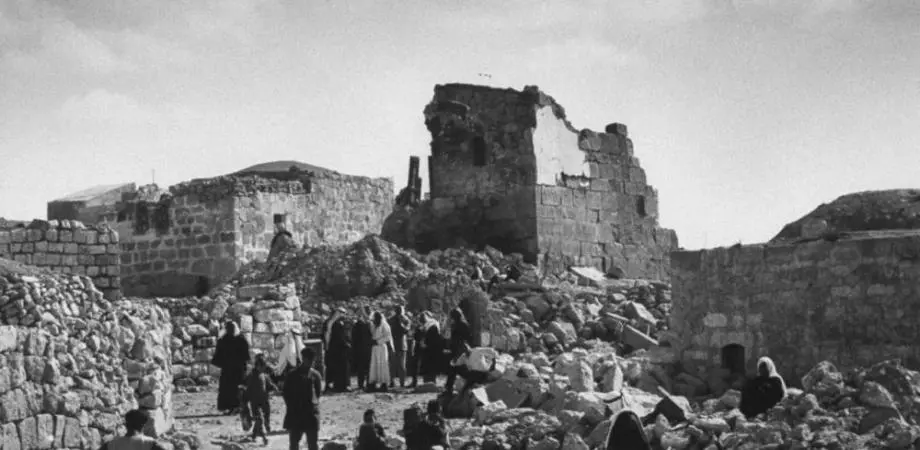
Haganah’s massacre in Balad al-Sheikh in 1947 - 31 Aralık gecesi düzenlenen baskında patlayıcılarla havaya uçurulan ve yaylım ateşine tutulan geleneksel taş evlerin enkazını ve katliamın hemen ardından köyde kalan sivillerin çaresiz bekleyişini görüyorsunuz.
Can you provide information about the Balad al-Sheikh Massacre (1947–48)?
The Balad al-Sheikh Massacre, which took place on the night of December 31, 1947, and January 1, 1948 during the final months of the British Mandate in Palestine, is one of the earliest and largest acts of mass violence of the 1948 Arab-Israeli War (and what Palestinians call the Nakba / Great Catastrophe).
The background, development, and consequences of this tragic event, which occurred in the village of Balad al-Sheikh, located in the southeastern suburbs of Haifa (near Tel Hanan), are as follows:
1. Background to the Events (The Cycle of Retaliation)
Following the announcement of the United Nations’ plan to partition Palestine in late 1947, civil conflicts escalated between Arab and Jewish communities in the region. Immediately before the massacre, a series of violent events occurred:
- December 30, 1947: The radical Zionist militia group Irgun attacked a crowd of Arab workers waiting in front of the Haifa Oil Refinery to find work, using grenades; 6 Arab civilians were killed and dozens wounded.
- Continuation of the Same Day: Immediately following this attack, Arab workers at the refinery became enraged and attacked Jewish workers inside, killing 39 Jewish workers. While the Jewish Agency condemned the attack, it simultaneously authorized the Haganah, the main Zionist military force, to carry out a retaliatory operation.

2. The Night of the Massacre: December 31 – January 1
Approximately 170 militiamen belonging to the Palmach, the elite striking force of the Haganah, raided Balad el-Sheikh and the neighboring Hawassa villages, heavily populated by workers and their families from the Haifa Oil Refinery, at midnight.
- Orders and Execution: Although the units carrying out the attack were theoretically instructed “not to harm women and children,” the actual operational order was “to kill the maximum number of adult men and damage property.” * Form of Attack: At midnight, while villagers were asleep, militiamen infiltrated from the slopes of Mount Carmel, opening fire on houses and blowing them up with grenades. Inside the houses, civilians were shot dead. According to historical records and military reports, women and children were also targeted in the ensuing chaos.
3. Casualties
The number of casualties varies according to sources:
- According to generally accepted historical data, between 60 and 70 Palestinian civilians (men, women, and children) lost their lives.
- Dozens of houses were completely destroyed.
- Two Haganah members were also killed in the ensuing fire from houses.
4. Historical Significance and Consequences
The Balad al-Sheikh Massacre had a far greater strategic impact than a simple local conflict:
- Flight and Demographic Change: This raid created a massive wave of fear and panic among the civilian Palestinian population in the Haifa region. Residents began to leave their homes to protect their lives. * Complete Evacuation of the Village: With the takeover of Haifa by Zionist militias in April 1948, the village of Balad al-Sheikh was completely surrounded by mortar fire, and the remaining inhabitants fled, resulting in the complete depopulation of the village. * Precursor to the Nakba: This event is an early preview of the larger massacres that would occur a few months later, such as Deir Yassin, and the mass expulsion of Palestinians from their lands (Nakba).
About the Author