There are images, but no action!(Official White House Photo by Daniel Torok)
Israel continues to attack Gaza and Lebanon despite having agreements. This shows that making an agreement with Israel is pointless. What do you think about this?
Dtesca May 22, 2026 9 minutes read
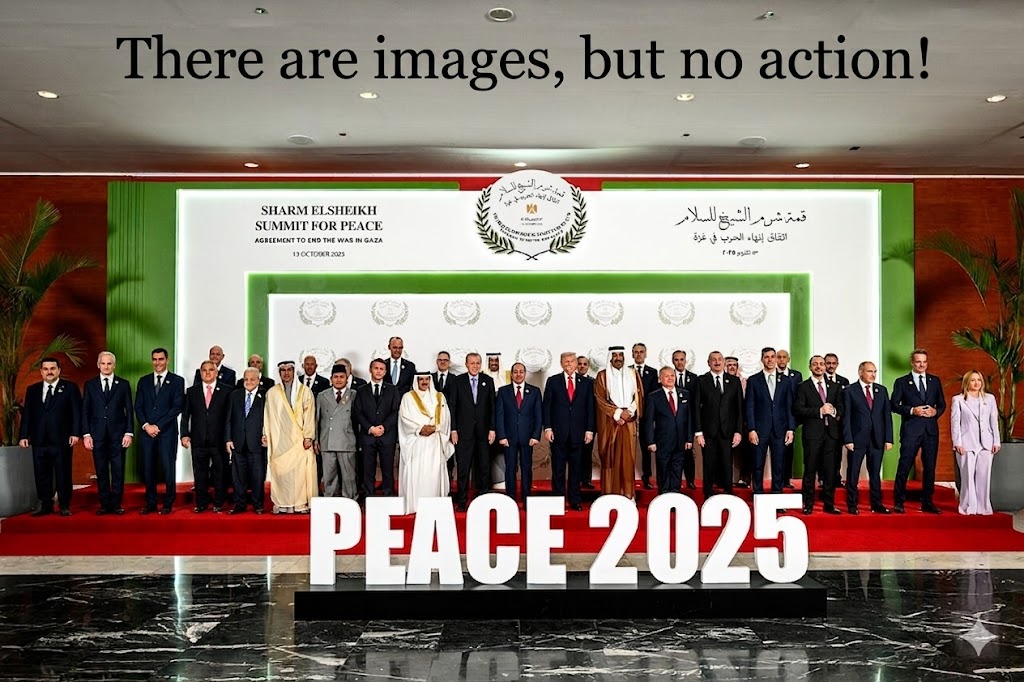
There are images, but no action!
President Donald Trump poses for a family photo with world leaders at the Tonino Lamborghini International Convention Center in Sharm El Sheikh, Egypt, Monday, October 13, 2025, during a summit on ending the war in Gaza and advancing peace in the Middle East. (Official White House Photo by Daniel Torok)
From the perspective of international relations and conflict resolution, the failure of agreed-upon ceasefires or peace agreements to fully translate into action on the ground is one of the most chronic and complex problems in the history of diplomacy. The situation you mentioned is a concrete example of the deep distrust between the parties and the structure known as the “security dilemma.”
In such situations, we can explain why agreements are fragile and why they appear “worthless” with a few key dynamics:
“Lack of Sanctions in International Law”
Unlike domestic legal systems, the international system does not have a global “police force” that forcibly dictates rules or agreements to states. When a state violates an agreement, the response is usually dependent on military, political, or economic power balances. If international pressure (e.g., UN sanctions or a clear stance from global powers) is insufficient to stop or deter the violating power, agreements can remain on paper.
Prioritization of Strategic and Military Objectives
States or conflicting actors often prioritize their military and strategic objectives over political texts. In the case of Israel, statements at the government level frequently emphasize that operations will continue “until the threat is completely eliminated.” This can lead to temporary agreements or ceasefire protocols being viewed by the parties as a “strategic breathing space/repositioning” rather than a permanent peace. “Asymmetric Warfare” and Multiplicity of Actors
The conflicts in Gaza and Lebanon are not between two regular armies. Non-state armed actors (Hamas, Hezbollah, etc.) and various factions within these actors are involved. When an agreement is signed:
Ensuring that all elements on the ground comply with this decision simultaneously can be difficult.
A single rocket launch or border violation can provide the other side with a justification for continuing extensive operations by saying, “The agreement is already broken, we are exercising our right to self-defense.”
The Role of Guarantor States
The permanence of international agreements is generally directly related to how much weight the global powers (USA, EU, regional countries, etc.) that mediate and guarantee the agreement can exert on the parties. The silence or flexible behavior of guarantor powers regarding violations eliminates the deterrent effect of the agreement. In short;
These processes demonstrate that diplomacy and international agreements alone are insufficient to control the situation; without strong international will, impartial oversight mechanisms, and deterrent sanctions, signatures on paper become vulnerable to abuse. This has been the biggest dilemma not only for the current conflict but also for many similar crises throughout history.

Israel always does this. But doesn’t this affect Israel’s credibility? Will any state enter into an agreement with Israel after this?
In international politics, the credibility of states is far different from moral credibility in individual relationships; it is based entirely on pragmatic grounds of interests and power balances.
As you mentioned, a state’s failure to fulfill its commitments or its bending of agreements in its favor seriously damages its “international reputation” and “political credibility.” However, the history of diplomacy has shown that even when credibility is at stake, states continue to make agreements with each other. There are several fundamental rational reasons behind this:
“Convergence of Interests” Comes Before Trust
One of the most basic rules of international relations is this: States have no permanent friends or enemies, only permanent interests. If a state’s vital security, economic, or geopolitical interest requires compromise with another state, negotiations are held regardless of the other party’s past record.
For example, despite similar tensions and violations in the past, many Arab countries (UAE, Bahrain, Morocco) normalized relations with Israel through the Abraham Accords in 2020. The motivation here is not mutual trust; it is shared security concerns against Iran, technology trade, and regional balances.
Agreements Are Made to “Limit Risks,” Not for “Trust”
States do not make agreements because they trust each other; on the contrary, they make agreements because they do not trust each other and want to reduce the cost of conflict. A state sitting down at the table with Israel in the future will not mean that it “trusts” it. It will only mean that it has calculated that a military or political compromise is less costly than continuing the conflict under the current circumstances. Asymmetric Power and Global Protection (The US Factor)
Normally, a state losing its credibility isolates it internationally. However, in Israel’s case, it has the very strong military, diplomatic, and economic shield of a global superpower like the US behind it. Other states, when making an agreement with Israel, take into account not only Israel but also the global guarantors behind that agreement (and their own relationships with those guarantors).
Lack of Alternatives and Geographical Reality
Especially for regional countries (neighbors like Egypt, Jordan, and Lebanon), engaging with Israel in some way is not a choice but a geographical and political necessity. No matter how much credibility is damaged; diplomatic contact will ultimately be necessary on vital issues such as border security, water rights, energy lines, or the need for an urgent ceasefire. In conclusion;
What has happened is undoubtedly seriously eroding Israel’s perception in the international public opinion and its image as a “trustworthy state.” However, due to the nature of the international system, if conditions change tomorrow, and if the national security or strategic interests of the parties require it, they can sit down at the table again as if nothing happened and sign new agreements. States do not seek trust at the table; they look at what they can get from that table.
But wouldn’t this attitude of Israel lead to the cancellation of the agreements it has made previously? Could the states that signed the Abraham Accords not cite Israel’s actions as the reason for their withdrawal from the agreements? Your question points to one of the biggest contradictions between public opinion and the cold reality of international politics. From an outsider’s perspective, it’s a perfectly justified and logical question: “If a state consistently violates agreements, why don’t other states cancel and withdraw from them to protect their prestige?”
However, in international law and diplomacy, things unfortunately don’t work with moral responses. In the context of the Abraham Accords, states like the United Arab Emirates (UAE), Bahrain, or Morocco have very clear, pragmatic reasons for not officially canceling the agreements citing Israel’s actions in Gaza and Lebanon.
We can examine this under a few headings:
The Agreements Were Not Starting from the “Palestinian Issue”
This is the most crucial point. The UAE, Bahrain, or Morocco did not sign these agreements to resolve the Palestinian cause or bring peace to Gaza. Therefore, the destruction in Gaza or Lebanon does not directly negate the motivation of these states to sign the agreement. What is the Real Motivation? The main concern of these countries was to establish a joint security umbrella with Israel and the US against Iranian-backed military formations and missile threats in the region. Furthermore, they have achieved billions of dollars in trade volume with Israel in areas such as military technology, artificial intelligence, agriculture, and cybersecurity. These states do not want to sacrifice these significant strategic and economic gains.
The US Factor and the Fear of “Burning Bridges”
The Abraham Accords are not just agreements with Israel; the architect, guarantor, and main driving force of this process is the US.
A single Arab country canceling the Abraham Accords would mean a direct challenge not only to Israel but also to Washington. Especially at a time when the White House is trying to further expand the agreements, no Gulf country wants to risk its relations with the US, jeopardize military aid, or jeopardize critical arms procurement projects like the F-35. The Excuse of Keeping the Diplomatic “Channel” Open
States that do not cancel the agreement usually resort to the following diplomatic argument to quell intense pressure from their own public opinion:
“If we cancel the agreement, withdraw our ambassadors, and completely sever ties, we will have no diplomatic influence or say over Israel. By remaining at the table, we can be more useful in delivering humanitarian aid to Gaza or mediating ceasefire negotiations.”
Indeed, throughout the process, the UAE and other regional countries strongly condemned Israel’s operations and declared “red lines,” but when it came to officially removing the signatures, they did not take that step. The level of diplomatic relations
Anketimize katılır mısınız?
Lütfen anketimize katılınız.
About the Author