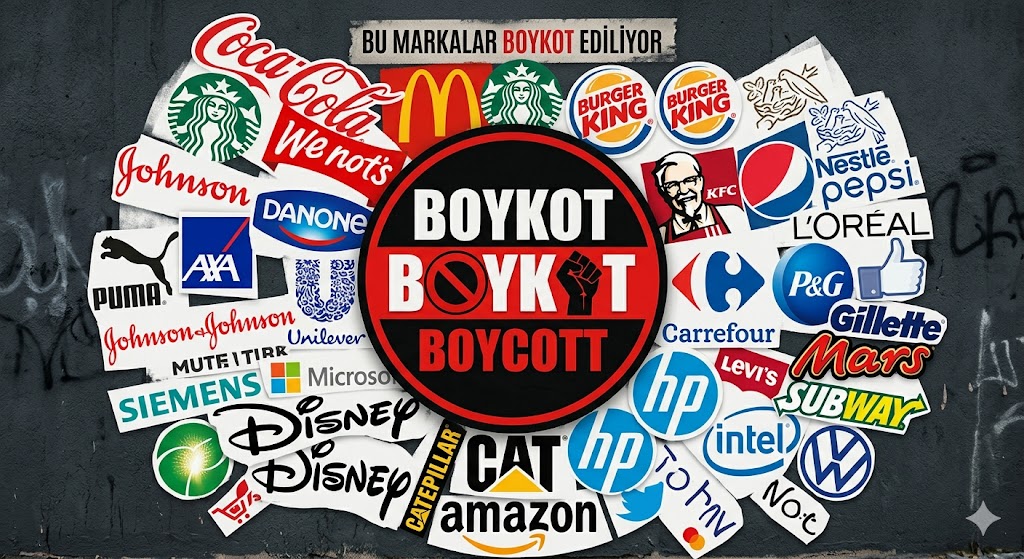
Yahudi sermayeli dünyada boykot edilen markalar
Which Jewish-owned brands are boycotted worldwide?
Brands boycotted in Turkey and worldwide for allegedly being “supportive of Israel/Zionism” or “Jewish-owned” are generally those directly of Israeli origin, those with large investments/R&D centers in Israel, or global giants that openly declare support for the Israeli army/government.
These boycott movements are mostly led by civil society organizations, the international BDS (Boycott, Divestment, Sanctions) movement, and consumer organizations on various social media platforms.
The most prominent global brands featured on boycott lists, categorized by sector, are:
- Food and Fast Food (Restaurants)
McDonald’s: Became one of the biggest targets of the global boycott after announcing that its branch in Israel would distribute free meals to Israeli soldiers.
Burger King, Subway, KFC, Pizza Hut: Similarly, they are on the lists due to their operations in Israel or statements made by their distributors. Starbucks: Joined the boycott wave due to the company suing a labor union for sharing a message of support for Palestine. - Beverage Sector
Coca-Cola Company: (Fanta, Sprite, Cappy, Fuse Tea, Damla Water) Has been at the top of boycott lists for years due to its factories and long-term investments in Israel (especially in the disputed occupied territories).
PepsiCo: (Pepsi, Yedigün, Fruko, Lipton, Tropicana, Doritos, Lay’s, Cheetos) Targeted because of its ownership of the Israeli-based SodaStream and Sabra brands.
Danone: (Sırma, Hayat Su) On the list due to its partnership in the dairy products company of the Strauss Group, one of Israel’s largest food companies.
Nestlé: (Erikli, Nescafe, Nesquik) Boycotted because of its majority stake in the Israeli-based food giant Osem and its R&D investments in the region. 3. Cleaning, Personal Care and Cosmetics
Procter & Gamble (P&G): (Ariel, Alo, Fairy, Prima, Head & Shoulders, Pantene, Gillette, Oral-B, Ipana) Included in the list due to its large R&D centers in Tel Aviv and its contributions to the Israeli economy.
Unilever: (Domestos, Cif, Elidor, Dove, Rexona, Algida, Lipton, Knorr) Criticized for its sub-brand Ben & Jerry’s attempt to obstruct the decision to withdraw from the occupied territories in Israel and for its commercial ties.
Reckitt Benckiser: (Finish, Calgon, Air Wick, Cillit Bang, Vanish) Boycotted due to its shareholder structure and alleged ties to Zionist funds.
L’Oréal Group: (Maybelline, NYX, Cerave, Garnier, Lancôme) Included in the list due to its production facilities in Israel, R&D investments, and past commercial partnerships. 4. Technology, Clothing, and Other Sectors
Puma: In the past, it was a primary target of the BDS movement due to its sponsorship of the Israeli Football Federation (the company announced it would end its sponsorship, but it remains on the lists).
HP (Hewlett Packard): It has been at the center of international boycotts for many years due to providing Israel with identity cards, biometric systems, and prison infrastructure technology.
IBM, Cisco, Intel, Dell: They are on the list due to their massive technology hubs in Israel, military software/hardware collaborations, and statements from their executives regarding financial aid to Israel.
Carrefour: It has drawn significant criticism for partnering with local chains in Israel and sending aid packages to soldiers. Note: Boycott lists may be updated periodically based on international political developments, official statements from brands, or share transfers. Consumers generally turn to alternative brands that are entirely domestically produced or have no commercial/organic ties to Israel (such as local cleaning, food, and clothing brands).
Are there any other brands?
Yes, there are other major brands and multinational companies that are not immediately obvious but are seriously boycotted globally, and are included in the lists of consumer movements and international organizations (especially the BDS – Boycott, Divestment, and Sanctions Movement).
Other prominent brands from different sectors are as follows:
- Digital Platforms, Travel and Technology
Booking.com / Airbnb / Expedia: These global travel and accommodation giants are directly on the BDS lists because they continue to list and profit from homes and hotels located in illegal Israeli settlements in East Jerusalem and the West Bank, which are Palestinian territories.
Amazon and Google: They have been protested and boycotted globally (including by their own employees) for a long time because of their involvement in the $1.2 billion “Project Nimbus,” which provides artificial intelligence and cloud computing services to the Israeli government and military.
Microsoft (and Xbox): They are included in the boycott lists because they provide database/cloud infrastructure to Israeli military systems and play a role in the technological infrastructure of Israeli prisons. 2. Heavy Industry, Energy and Automotive (Construction Equipment)
The boycott lists include not only household consumer goods, but also global brands that produce construction equipment used in demolitions in Palestine:
Caterpillar (CAT): This brand is most targeted by international human rights organizations because it supplies the Israeli army with D9 military bulldozers, specially armored for demolishing Palestinian homes, olive groves, and properties.
JCB and Volvo: These brands are boycotted because their excavators and construction equipment are actively used in illegal settlement construction and home demolitions in the West Bank.
Siemens: Its household appliances and industrial products are included in the boycott because it is the main contractor for the “Euro-Asia Interconnector” project, which aims to connect illegal settlements in Israel to the European energy grid via underwater electricity cables. Chevron (Caltex and Texaco): It is the main global company extracting natural gas reserves that Israel claims in the Eastern Mediterranean and is the biggest target of boycott in the energy sector due to the billions of dollars it injects into the Israeli economy.
- Clothing, Footwear and Sports
Reebok: It is one of the sports brands newly added to the boycott lists due to some corporate partnerships with Israel and alleged ties to Zionist funds.
Marks & Spencer (M&S): It is a classic brand on boycott lists, especially in the UK and Europe, due to its very deep commercial ties with Israel since its establishment and its historical support for the Israeli economy.
Victoria’s Secret: It is at the center of criticism because one of its main suppliers is the Israeli-based textile giant Delta Galil. - Finance and Insurance
AXA Insurance: It faces a very large boycott campaign in Europe due to its fund investments in Israel’s largest banks (Bank Leumi, Bank Hapoalim, etc.) and the arms manufacturer Elbit Systems. Barclays Bank: It is being protested globally, primarily in the UK, for providing billions of dollars in loans and financing to global defense companies that supply weapons and military technology to the Israeli army. - Logistics and Transportation
Maersk: One of the world’s largest container shipping companies, Maersk is the main target of maritime shipping and logistics boycotts because it transports military cargo and weapons raw materials from the US to Israel. In short: Boycott movements are no longer limited to biscuits, detergents, or colas on supermarket shelves; they encompass a very wide global network, from the search engines we use in the digital world to the sites where we book hotels while traveling, and the infrastructure companies that bring electricity to our homes. Consumers are preferring local alternatives or international brands that remain completely neutral during these crises.
Are there any other brands in Turkey?
Boycott movements in Turkey have recently been progressing along two main lines. Firstly, large companies (especially domestic holding companies) that are alleged to have organic or commercial ties to Israel; secondly, entirely domestic brands that are being protested by consumers due to political/media polarization and union crises within Turkey.
Other brands operating in the Turkish market and frequently appearing on current lists are as follows:
- Turkish-Based Companies Boycotted Due to Israeli Connections
There are holding companies and brands whose capital is in Turkey but which have been included in boycott lists by the BDS (Boycott, Divestment, Sanctions) movement and civil society organizations due to their investments, energy partnerships, or commercial relations in Israel:
Zorlu Holding (Vestel & Regal): Zorlu Holding is one of the largest Turkish-owned investors in Israel. Due to its partnerships in power plants generating electricity in Israel (such as the Dorad Natural Gas Power Plant), its technology and white goods brands Vestel and Regal are at the top of civil boycott lists. 1. İçdaş: It has been targeted by industry-wide boycotts and protests due to its significant share in steel exports to Israel.
- Food, Coffee and Restaurant Chains
EspressoLab: Despite being one of the largest third-generation coffee chains based in Turkey, its franchise structure, financier allegations, and local protests have made it one of the brands frequently mentioned on boycott maps in Turkey.
Doğuş Group Restaurants (Nusr-Et & Günaydın): The popular luxury restaurant chains within the Doğuş Group are sometimes included in protest lists due to the group’s general commercial relations and global partnership structures.
CarrefourSA: Although it operates in Turkey in partnership with Sabancı Holding, its branches in Turkey were directly affected by the boycott wave due to its French parent brand Carrefour sending aid packages to the Israeli army and cooperating with local markets there. - Domestic Brands Boycotted in Turkey for Political or Union Reasons
The boycott agenda in Turkey is not limited only to foreign policy. There are major domestic brands that have been publicly boycotted, particularly by the leadership of the main opposition party (CHP) and various labor unions, on the grounds of “media monopolization, violations of workers’ rights, or allegations of irregularities in public tenders”:
D&R and İdefix: These giant book/culture stores and online shopping platforms, part of the Turkuvaz Media Group, are on the boycott list by opposition voters and civil society organizations due to the media group’s political stance and allegations of monopolization.
ETS Tur: ETS Tur, one of the largest domestic brands in the tourism sector, is among the brands mentioned in boycott lists as a result of past political ties and sectoral criticisms.
İhlas Ev Aletleri: Political reactions against the İhlas Group, which includes media outlets such as TGRT and İhlas News Agency (İHA), have been reflected as calls for a boycott of the group’s commercially produced products such as home appliances and heaters. Albayrak Media and Anadolu Agency: The Albayrak Group, which includes media outlets such as Yeni Şafak and TVNET, and Anadolu Agency, the state’s official news agency, are periodically subjected to calls for mass boycotts due to allegations of polarization and bias in their news reporting.
Summary of Consumer Trends: When boycotting foreign brands, Turkish consumers generally turn to domestic food brands (Torku, Ülker, Eti, etc.) or domestic water/cleaning brands. However, when it comes to the brands of the aforementioned domestic holdings (Zorlu, Turkuvaz, etc.), the justification for the boycott is “Turkey’s internal political and economic balance rather than international politics.”
Are there no other Jewish-owned brands in Turkey that are being boycotted?
When examining brands known as “Jewish-owned” or those boycotted in Turkey for allegedly supporting Israel, it’s crucial to recognize the complexity of the situation, with its legal, commercial, and social dimensions.
Firstly, there are virtually no mass-consumption brands directly originating from Israel that are sold on supermarket shelves in Turkey. The vast majority of boycotted brands are multinational corporations based in the US or Europe. The reasons behind the boycotts include either the fact that their founders/major shareholders are of Jewish origin, or that the company directly or indirectly supports the Israeli economy, military, or occupied territories.
Other global and local brands that are very strong in the Turkish market and frequently appear on boycott lists include:
- Cosmetics, Beauty and Health Sector
Giant brands that rank at the top of boycott lists in the cosmetics and personal care world are generally targeted due to their established capital structures and investments in Israel:
Estée Lauder Companies: (Clinique, MAC, Bobbi Brown, Origins, Jo Malone, Tom Ford Beauty) The founder Estée Lauder’s family (especially Ronald Lauder) is of Jewish origin and actively manages institutions such as the Jewish National Fund. The company is at the top of international lists due to these organic and financial ties.
Ahava: A directly Israeli brand. Cosmetic products made from Dead Sea minerals are sold in Turkey through distributors (especially in some luxury cosmetics stores and online platforms). It is one of the main targets of the global BDS movement on the grounds that it sources raw materials from occupied territories. Johnson & Johnson: (Listerine, Neutrogena, Johnson’s Baby) is boycotted due to its massive medical and technological investments in the country since the establishment of the Israeli state, as well as the “Israel Jubilee Award” it received.
- Technology, Communications and Cybersecurity
Intel: The technology giant Intel, whose processors are found in almost one out of every two computers, is the largest private sector employer in Israel and has invested billions of dollars in new chip factories (fabs) in the country.
Check Point Software Technologies: This brand, which provides the cybersecurity infrastructure of many large companies, banks and public institutions in Turkey, is a directly Israeli company headquartered in Tel Aviv. Although consumers do not buy directly, it is subject to boycott calls at the corporate level.
Waze: Waze, a navigation application widely used in Turkey, is originally an Israeli startup and was later acquired by Google. 3. Clothing, Luxury Goods and Fashion
In the fashion world, the following brands are boycotted due to the financial funds or production partnerships of their main holding companies:
Tommy Hilfiger, Calvin Klein, Michael Kors: The parent companies (e.g., PVH Corp and Capri Holdings) and major shareholders of these brands are listed due to allegations of financial support to global Zionist funds and NGOs close to Israel.
Nike and Adidas: While not directly “Jewish companies,” they are periodically included in boycott waves due to their distribution networks in Israel, sponsorships of local sports clubs, and certain corporate stances on a global scale.
- Food and Other Brands on Supermarket Shelves
Mondelez International: (Milka, Oreo, Toblerone, Kent, Olips, Falım, Jacobs) This US giant, which has a very large share of the Turkish food market, has been added to the boycott lists because of its investments in Israeli-based food start-ups and food technologies. Why Aren’t Brands Like Sütaş, Ülker, and Eti on the Lists? On the contrary, in boycott movements in Turkey, consumers choose brands with entirely domestic capital or no ties to Israel, such as Sütaş, İçim, Torku, Ülker, Eti, Hayat, and Saka, as “alternatives” to foreign giants like Danone, Nestlé, or P&G (Ariel, Fairy, etc.), and the sales of these brands increase during boycott periods. A Warning About Important Misinformation
One of the most misunderstood situations in boycott processes in Turkey is the Starbucks example.
Starbucks’ founder, Howard Schultz, is of Jewish origin. However, Starbucks does not have a single branch in Israel (they completely closed their operations there in 2003). The reason for the boycott is not its capital, but rather the company’s lawsuit against a US labor union for “damaging its brand value” after the union posted pro-Palestinian tweets. Therefore, the reason for the boycott is not directly ethnic/religious capital, but corporate crisis management.
Furthermore, brands like Coca-Cola, Fanta, Algida, and McDonald’s, which are sold in Turkey and included in boycott lists, are operated in Turkey by Turkish holding companies (such as Anadolu Group) or local licensees, providing employment to thousands of Turkish citizens. When consumers make boycott decisions, they should consider these complex commercial and legal ties (the balance between global profit margins and local employment).
About the Author