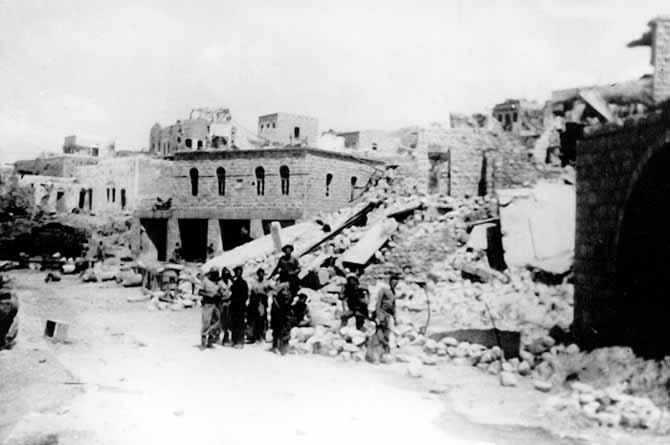
By Unknown author - Palmach archive Yiftach 3rd Battalion Hachsharot 2 album 4/13הכשרת ארזאלבום: חטיבת יפתח - הגדוד השלישי - הכשרות - 2תאור התמונה:בעין זיתון לאחר הקרבמופיעים בתמונה:תאריך צילום: 1948מס' תמונה: 24394נתקבל מ:, Public Domain, https://commons.wikimedia.org/w/index.php?curid=57428878
Can you give us information about the Ein el-Zeitun Massacre (1948)?
The Ein el-Zeitun (Ayn al-Zaytun) Massacre was a massacre that took place on May 1, 1948, in a Palestinian village near Safed during the 1948 Arab-Israeli War (and what Palestinians call the Nakba / Great Catastrophe).
This event, which occurred in Palestine under the British Mandate, is one of the tragic developments that fundamentally changed the demographic and military structure of the region.
Background and Development of the Event
Ein el-Zeitun was a village surrounded by olive trees, inhabited by approximately 800 Palestinian Arabs at the time. It was strategically targeted to open the way for an attack on the Arab neighborhoods of Safed.
- Attack and Occupation: The attack was carried out by the 3rd Battalion of the Palmach, the elite striking force of the Haganah, under the command of Moshe Kelman. For the first time in the region, homemade mortars called “Davidka” were used, and the village was quickly captured.
Destruction of the Village: After the village fell, most of the local population fled. Many of the remaining civilians were forcibly displaced. Palmach soldiers began destroying the houses in the village by blowing them up.
The Moment of the Massacre and Executions
After the village was captured, dozens of Palestinian men, aged between 20 and 40 (some sources say younger), were taken prisoner.
- Execution Order: The prisoners were taken to a deep valley between Ein el-Zeitun and Safed and kept there for two days with their hands and feet bound. Then, on the orders of Battalion Commander Moshe Kelman, it was decided to execute the prisoners to get rid of them as a “burden.” Although many soldiers opposed this order, two volunteer soldiers were found to carry out the execution. * Losses: According to official military documents and historians’ accounts (particularly Israeli historians such as Benny Morris and Ilan Pappé), over 70 unarmed Palestinian prisoners were executed by firing squad in this valley. Some eyewitnesses and later international reports indicate that bodies of women, children, and infants were also found around the mosque.
- Concealment of Evidence: Two days after the massacre, fearing the arrival of United Nations or British investigators, a group of soldiers, including Israeli writer and former soldier Netiva Ben-Yehuda, were tasked with untying and burying the bodies.
Consequences and Effects of the Massacre
Psychological Warfare and Migration: This massacre in Ein el-Zeitun and the complete destruction of the village created a tremendous wave of fear among the Arab population in the neighboring city of Safed. It played a decisive role in breaking the resistance of the Palestinians in the region, leading to the mass expulsion of thousands of people from their homes in the days that followed.
Following the massacre, the village was completely depopulated, and the stone ruins of the houses lay among the olive groves. Today, only a few ruined stone houses and arched gate remnants remain in the area where the village once stood. The famous novel “Bab al-Shams” (The Gate of the Sun) by Palestinian author Elias Khoury is also partly based on oral history accounts from this village.
Visual History Note: There is no known photographic record of the massacre directly at the moment of execution (the valley where the prisoners were shot). However, the first image above directly shows the events of those few days when the commanding officers and soldiers who ordered the massacre dynamited the houses to completely depopulate the village.
About the Author