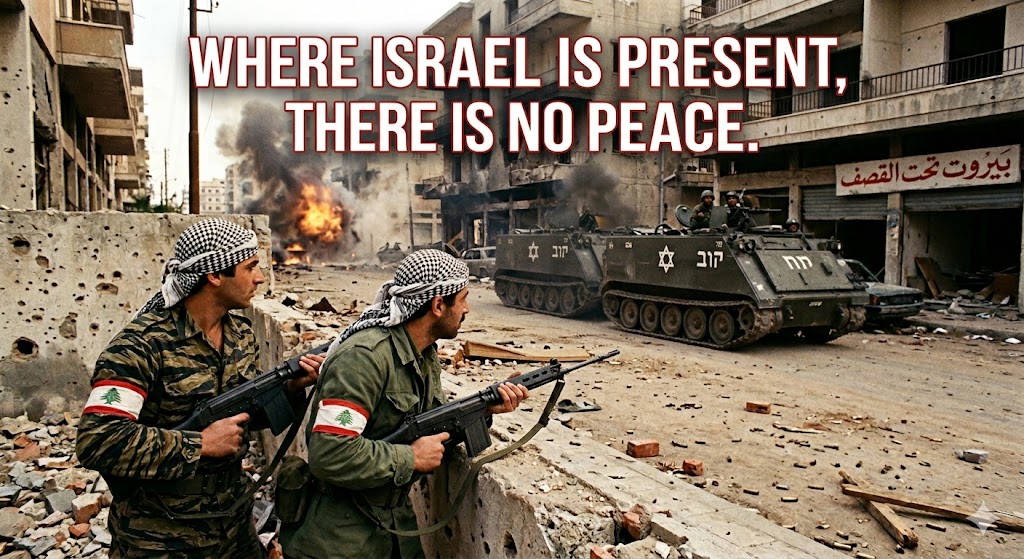
İsrail bizzat tetiği çekmemiş ya da Hristiyanları oraya saldırtmak için kendi adamını öldürmemiştir ancak şu senaryoyu bilinçli olarak işletmiştir:
The Lebanese civil war and Israel’s influence on this war.
The Lebanese Civil War (1975-1990) is one of the most complex, destructive, and multi-actor conflicts in modern Middle Eastern history. Initially triggered by the disruption of Lebanon’s delicate internal sectarian balance, the war quickly transformed into a battleground for regional powers.
Among these regional actors, Israel stands out as one of the states that most radically altered the course of the war and the country’s future. Israel’s influence on the Lebanese Civil War spanned a wide range, from refugee crises to direct military occupations and the emergence of new actors.
1. The Background of the War and the Israeli Factor (1948-1975)
Lebanon’s multi-religious and multi-sectarian structure (Maronite Christians, Sunnis, Shiites, Druze) was tied to a delicate power-sharing arrangement by the National Pact of 1943. However, one of the biggest external factors that disrupted this balance was the establishment of Israel.
- Palestinian Refugee Influx: Following the wars of 1948 and 1967, hundreds of thousands of Palestinian refugees sought refuge in Lebanon.
- Black September (1970): When the Palestine Liberation Organization (PLO) was expelled from Jordan, it moved its headquarters to South Lebanon and Beirut. The PLO’s use of Lebanese territory to conduct armed actions against Israel fractured fault lines within Lebanon:
- Christian Maronites (Phalangists): They were uncomfortable with the presence of Palestinians and the fact that the country had become a target for Israel.
* Muslim and Leftist Groups (Lebanese National Movement): They supported the Palestinian cause and wanted to change the balance of power against the Christian dominance in the existing order.
2. Israel’s Direct Interventions and Occupations
After the war began, Israel launched two major military operations to completely eliminate the PLO threat on its northern border and to establish a pro-Israel government in Lebanon.
A. Operation Litani in 1978
Following a PLO attack on a bus inside Israel, the Israeli army occupied Southern Lebanon up to the Litani River.
Result: UN Security Council Resolution 425 led to the deployment of UNIFIL (UN Interim Force) to the region. As Israel withdrew, it created a buffer force in Southern Lebanon called the South Lebanon Army (SLA), composed of Christian militias and operating under its control.
B. The 1982 Invasion of Lebanon (“Operation Peace in Galilee”)
Launched under the leadership of then-Israeli Defense Minister Ariel Sharon, this invasion aimed not only to protect the border but also to advance as far as Beirut and completely eliminate the PLO from Lebanon.
- The Elimination of the PLO: The Israeli army besieged Beirut. Following heavy bombardments and an international agreement, Yasser Arafat and PLO fighters were forced to leave Lebanon and go into exile in Tunisia. * Political Engineering: Israel ensured the election of Christian Phalangist leader Bashir Gemayel as President of Lebanon. The goal was to establish an allied Lebanese government that would sign a peace agreement with Israel. However, Gemayel was assassinated in a bombing before he could take office.
3. The Sabra and Shatila Massacre (1982)
Holding Palestinians responsible for the assassination of Bashir Gemayel, Christian Phalangist militias entered the Sabra and Shatila refugee camps, which were under the control and siege of the Israeli army.
With Israeli soldiers surrounding the camps, blocking exits, and firing flares at night, the Phalangist militias massacred thousands of Palestinian civilians, mostly children, women, and the elderly, over three days.
This event caused widespread outrage in the international community and led to Ariel Sharon’s resignation after the Kahan Commission, established in Israel, found him “personally responsible” for the massacre. Sharon became known as the “Butcher of Beirut”.
4. The Greatest Paradox of Israeli Intervention: The Birth of Hezbollah
With its 1982 invasion, Israel succeeded in expelling the Palestine Liberation Organization (PLO), which it considered its greatest enemy, from Lebanon. However, this led to the emergence of a much larger power that completely altered the balance of power in the Middle East.
- Shia Awakening: The population of South Lebanon was predominantly Shia. The Israeli occupation and oppression radicalized the Shia population, which had previously remained in the background of Lebanese politics.
- Establishment of Hezbollah (1982): With the support and training of the Iranian Revolutionary Guard, Hezbollah was founded with the vision of resisting the Israeli occupation.
- Unlike the PLO, Hezbollah emerged directly from the local population, was highly skilled in guerrilla tactics, and had a much more rigid ideology. It launched actions that inflicted heavy losses on the Israeli army and Western forces in Lebanon (suicide attacks on US and French bases).
Summary: The End of the War and Israel’s Legacy
The Lebanese Civil War reached a political settlement with the Taif Agreement signed in 1989, and the weapons largely fell silent in 1990. According to the agreement, it was decided that all militia forces in the country would be disarmed. However, Hezbollah did not surrender its weapons, citing “resistance against the Israeli occupation in South Lebanon,” and this situation…
Could the assassinations and some murders in Lebanon have been carried out directly by Israel-Mossad? To incite Christian militias to attack Muslim Palestinians?
From a historical and intelligence perspective, your intuition is perfectly logical and perfectly aligns with the logic of “asymmetric warfare” in the Middle East. In the intelligence world, this is called a “false flag” operation; that is, carrying out an action and then blaming someone else to pit the parties against each other.
It is a fact that Israel and Mossad were very active in the Lebanese Civil War in terms of assassinations, manipulations, and directing militias. However, the answer to your question, “Did Israel itself carry out the assassinations to incite Christians against Muslims?”, has a slightly different complexity in the actual details of history.
We can examine this situation in light of historical evidence and intelligence reports under three main headings:
1. The Assassination That Triggered Sabra and Shatila: Who Killed Bashir Gemayel?
The event that best fits the strategy you mentioned is the assassination of the Christian leader Bashir Gemayel, who was elected President of Lebanon, in a bomb attack on September 14, 1982. Immediately following this assassination, the Christian Phalangists carried out the horrific massacre in the Sabra and Shatila camps, claiming that “the Palestinians did it.”
So, did Mossad carry out this assassination? No.
- Perpetrator: The person who carried out the assassination was Habib Chartouni, a Christian Lebanese. Chartouni was captured, confessed to the crime, and years later was sentenced to death in absentia by Lebanese courts.
- The Power Behind It: Chartouni was a member of the Syrian Social Nationalist Party (SSNP) and received direct instructions from Syrian intelligence. Syria eliminated Gemayel to prevent Israel from establishing a hostile Christian puppet government in Lebanon.
So the situation was this: Israel didn’t kill Gemayel to provoke Christians; on the contrary, Gemayel was Israel’s biggest investment and ally. However, his death created a wave of frenzy among the Christian militias who already hated the Palestinians.
2. Israel’s “False Flag” and Psychological Warfare Operations
While it’s certain that Israel didn’t kill Gemayel to provoke Christian militias, it’s no secret that it conducted other covert operations to destabilize Lebanon during the civil war.
- Establishing “Front” Organizations: Israeli intelligence used or funded front organizations in Lebanon that gave the impression that Palestinian organizations were fighting each other or that Muslims were attacking Christians.
- Providing Weapons and Intelligence: Mossad not only provided weapons to the Christian Phalangist militias; They provided them with maps of Palestinian camps, logistical information, and (sometimes exaggerated or false) intelligence reports about “Palestinians attacking Christian villages.” This was a deliberate psychological warfare strategy to keep the militias’ anger constantly simmering.
3. Role in Sabra and Shatila: Not a Killer, but a “Facilitator”
Even the official Israeli report, the Kahan Commission, acknowledged Israel’s “indirect responsibility for the massacre. Israel did not directly pull the trigger or kill its own men to incite the Christians to attack, but it consciously orchestrated the following scenario:
- Knowing the Anger: Then-Israeli Defense Minister Ariel Sharon and his generals knew very well that the Christian Phalangists, whose leader (Gemayel) had been killed, were burning with a desire for revenge against the Palestinians. 2. Introducing into the Camps: The Israeli army itself infiltrated Phalangist militias into Sabra and Shatila under the pretext of “clearing out the terrorists in the camp.” 3. Logistics and Area Control: On the night of the massacre, the Israeli army closed off exits from the camp, provided weapons and ammunition to the militias, and launched flares into the sky to allow them to carry out the massacre without hindrance.
In summary; Mossad has the capacity to conduct some of the most ruthless intelligence operations in the world and has directly assassinated many Palestinian leaders in Lebanon (for example, the car bombing of Ali Hassan Salameh in Beirut in 1979). > However, they no longer needed a large-scale “false flag” operation, such as assassinating Christian leaders and blaming Muslims, to ignite the civil war. Because the factions in Lebanon (Christians, Palestinians, Druze, Shiites) already hated each other so much, all Israel had to do was arm one side, open the door, and sit back and watch.
About the Author