A state founded on terrorism: Israel!
What are the terrorist organizations operating in Israel?
When examining the history and current political map of Israel, the issue of “structures involved in acts of terror or violence” is addressed in two main periods: Zionist paramilitary organizations in the pre-establishment period of Israel and extremist Jewish groups established by Israel or recognized internationally as terrorist organizations in the modern period.
We can summarize these structures chronologically and qualitatively as follows:
1. The Pre-Establishment Period of the State of Israel (Zionist Paramilitary Organizations)
Before the establishment of the State of Israel in 1948, radical nationalist Jewish organizations existed in the Palestinian territories under British Mandate, using methods such as bombing, assassination, and massacre against both the British administration and the Arab civilian population. Many of these organizations were officially declared “terrorist organizations” by the British administration at the time:
- Irgun (Etzel): A revisionist Zionist paramilitary organization that operated between 1931 and 1948. Their best-known actions are the bombing of the King David Hotel, the British administrative center in Jerusalem, in 1946 (91 dead) and the Deir Yasin Massacre in 1948. One of the organization’s leaders, Menachem Begin, later became Prime Minister of Israel.

- Lehi (Stern Gang): This group, which had a more radical stance than Irgun, was founded in 1940 by Avraham Stern. They are known for their assassinations of British officials. Their most notable actions are the assassinations of British Middle East Minister Lord Moyne (1944) and UN mediator Count Folke Bernadotte (1948). One of their leaders, Yitzhak Shamir, also later served as Prime Minister of Israel.
Haganah: Although primarily established as a “defense force” and forming the backbone of today’s Israel Defense Forces (IDF), it played an active role, particularly during its establishment, in forced displacement operations targeting Palestinian villages and in some acts of sabotage (for example, through its Palmach unit).
2. Modern Extremist and Radical Jewish Organizations
After the establishment of the State of Israel, several groups emerged that organized acts of violence, particularly against Palestinians, advocated for the expansion of the 1967 borders, and held racist ideologies. Some of these groups have been recognized as terrorist organizations by Israeli law, the US, and the European Union:
- Kah (Kach) and Kahane Chai: Founded by Rabbi Meir Kahane, this is a far-right, racist, and ultra-nationalist organization. They advocated for the complete expulsion of Arabs from the region. Following the massacre of 29 Muslims by group sympathizer Baruch Goldstein at the Mosque of Abraham in Hebron in 1994, the group was declared a terrorist organization and banned by many international powers, including the Israeli government.

- Hilltop Youth and the “Price Tag” Movement: These are radical youth groups organized in illegal Jewish settlements in the West Bank. They lack a hierarchical leader but are ideologically united. They are known for their acts of arson against Palestinian homes, cutting down olive trees, attacking mosques/churches, and retaliating against eviction orders. Israeli security forces (Shin Bet) consider the actions of these groups as “Jewish Terrorism.”
- Lehava: This is a far-right and racist group whose primary goal is to prevent marriages between Jews and non-Jews (especially Arabs). Due to its acts of violence and hate speech, it has frequently faced legal prosecution in Israel, and there have been serious political debates about placing it on the terror list.
In the modern era, civilian attacks, particularly those carried out by illegal settlers in the West Bank, are frequently referred to as “settler terrorism” by the international community (including UN reports).
Palmach nedir?
Palmach (Hebrew acronym Plugot Mahatz / פלמ”h – “Assault Troops” or “Striking Forces”) was the elite and professional special forces unit of the Haganah, the main paramilitary army of the Jewish community during the British Mandate period before the establishment of the State of Israel. Founded on May 15, 1941, this structure, both through its military tactics and the leaders it trained, formed the institutional backbone of modern Israeli history and the Israel Defense Forces (IDF).
The key characteristics and historical role of the Palmach unit are as follows:
1. Founding Purpose (Nazi Threat)
Palmach was established during World War II in response to the rapid advance of Nazi Germany under General Rommel in North Africa. In anticipation of a potential British withdrawal from the Middle East and the occupation of Palestine by the Axis powers (Nazis and their allies), it was organized as a “guerrilla and underground resistance force” in cooperation with the British army. The British provided strategic and military training support to this unit in its early stages.
2. Structure Sustained by the “Kibbutz” System
When the Nazi threat diminished during World War II and the British cut off financial support to Palmach, the organization developed a unique financing model to maintain its existence. Units were placed in collective agricultural farms called Kibbutz. According to the system, Palmach members:
- Worked as agricultural laborers in kibbutzs for 14 days a month (thus covering their housing and food expenses),
- Received intensive military training for 8 days,
- Had 7 days off.
This situation enabled Palmach to become a self-sufficient economic structure and also created a very strong ideological bond and camaraderie culture among its members.
3. Special Units
Not remaining solely as a ground unit, Palmach established specialized underground units within itself:

- Palyam (Naval Unit): This later formed the basis of the Israeli Navy. The unit organized the illegal transport of Holocaust survivors from Europe to Palestine (Aliyah Bet), circumventing the British blockade.
- Air Unit (Palavir): The core of the future Israeli Air Force.
- German Detachment (Ha-Machlaka Ha-Germanit): An agent/commando unit trained to conduct covert operations in the Middle East and the Balkans, impersonating Germans and fluent in German language and culture to counter potential Nazi German infiltration.
- Arab Detachment (Ha-Mista’arvim): Agents who infiltrated the Arab population to gather intelligence and conduct sabotage operations, completely Arabized in appearance and language.
4. Changing Relations with the British and the 1948 War
After the Nazi threat passed, Palmach and its parent organization Haganah turned against British policies restricting Jewish immigration, carrying out sabotage actions against British infrastructure facilities, bridges, and railways. It began.
When the 1948 Arab-Israeli War (which Palestinians call the Nakba / Great Catastrophe) began, the Palmach had three large brigades comprising approximately 5,000 trained soldiers. It played a striking role on the most critical fronts of the war (the road to Jerusalem, the Negev Desert, and the Galilee region). It spearheaded the evacuation of Palestinian villages and the capture of strategic points.
5. Disbandment and Legacy
After the establishment of the State of Israel, Prime Minister David Ben-Gurion did not want military structures with “independent/partisan ideologies” to remain within the state. In line with his decision to create a single, centralized national army (IDF), he disbanded the Palmach in November 1948.
Nevertheless, officers trained within the Palmach formed Israel’s military and political elite for decades. Many important figures in Israeli history emerged from this unit:
- Yitzhak Rabin (Former Chief of Staff and (Prime Minister)
- Moshe Dayan (Former Chief of Staff and Minister of Defence)
- Yigal Allon (Commander of Palmach and former Acting Prime Minister)
- Haim Bar-Lev (Former Chief of Staff)
Which Israeli statesmen have served in or sympathized with these terrorist organizations?
In Israeli political history, there are many critical figures who rose to the highest levels of the state after emerging from paramilitary organizations defined as “terrorist organizations” by the pre-establishment British Mandate, or from groups deemed radical/racist and banned in the modern era.
We can classify these figures according to their level of service within the state and the organizations they belonged to as follows:
1. Founding Leaders Who Reached the Level of Prime Minister
In early Israeli politics, leaders of radical Zionist organizations that carried out underground activities against British rule later formed legitimate political parties and ascended to the position of Prime Minister:

- Menachem Begin (Leader of Irgun): He was the commander-in-chief of the Irgun organization, which carried out bombing and assassination operations against the British and the Arab civilian population between 1943 and 1948. He was wanted by the British government as “terrorist number 1” for ordering the King David Hotel massacre. In 1977, he became Prime Minister of Israel at the head of the Likud Party and in 1978, he signed the Camp David Peace Agreement with Egypt, receiving the Nobel Peace Prize.
- Yitzhak Shamir (Leader of the Lehi/Stern Gang): He was one of the three top leaders of Lehi, considered the most radical founding underground organization. He was among the planners of the assassinations of British Minister Lord Moyne and UN mediator Count Bernadotte. He was arrested twice by the British and escaped from camps. After the establishment of the state, he held high-ranking positions in the intelligence agency MOSSAD, and then served as Prime Minister of Israel between 1983-1984 and 1986-1992.
2. Radical Sympathizers Serving as Ministers in the Modern Era
In the period following the establishment of the state, individuals originating from the Kach (Kah) movement, which is directly banned by Israeli law and the international community as “racist/terrorist,” have risen to very critical ministerial positions in contemporary Israeli politics:

- Itamar Ben-Gvir: He is currently the Minister of National Security in the Israeli government, responsible for law enforcement, the police, and disarmament/armament policies. In his youth, he led the youth wing of the racist Kach movement, which Israel has declared a terrorist organization. Due to his extremely radical ideas and criminal record, he was not even accepted into compulsory military service in the Israeli army (IDF). He himself has admitted that he kept a photograph of Baruch Goldstein, the terrorist who carried out the Ibrahimi Mosque massacre in 1994, hanging in his house for years. * Bezalel Smotrich: He is the current Minister of Finance and the minister responsible for civil administration in the West Bank. In 2005, during the Gaza withdrawal protests, he was caught with 700 liters of fuel and explosives intended to sabotage highways and infrastructure, and was held in custody for three weeks by the internal intelligence service Shin Bet. He is known for providing ideological and political support to the radical “Hilltop Youth” groups that attack Palestinian villages in the West Bank.
3. Other Important Statesmen and Presidents

Reuven Rivlin (Former President): Rivlin, who served as President of Israel from 2014 to 2021, grew up with the revisionist ideology of Ze’ev Jabotinsky, the mastermind behind the Irgun organization, and participated in Irgun’s civilian sympathizer structures during his youth. *

Üyesi
Geulah Cohen (Former Member of Parliament and Deputy Minister): Cohen, who worked as a radio announcer for the Lehi (Stern Gang) underground organization and participated in its operations, entered parliament (Knesset) after the establishment of the state, became one of the founders of the right-wing Tehiya party, and served as Deputy Minister of Science.
King David Hotel Bombing
The King David Hotel bombing (or massacre as it is commonly known) was one of the deadliest and most pivotal acts of terrorism in Middle Eastern history, taking place in Jerusalem on July 22, 1946.
The attack was organized and carried out by the radical Zionist underground organization Irgun (Irgun Zvai Leumi) in British Mandate Palestine.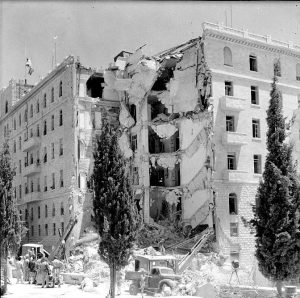
[Image caption: Photo of the hotel after the bombing, published in the Jerusalem Post, 1946 – https://upload.wikimedia.org/wikipedia/commons/f/f4/King_David_Hotel_bombing%2C_Jerusalem_1946.jpg]
Background and Reason
The main target of the attack was the south wing of the King David Hotel, Jerusalem’s most luxurious hotel. This section served as the civilian administrative center (secretariat) of the British Mandate administration and the headquarters of the British army.
The primary motivation behind the attack was the recent British operation, Operation Agatha (also known as “Black Saturday”). British soldiers had raided the Jewish Agency in response to the wave of Zionist insurgency and seized numerous classified documents directly linking it to the armed actions of the underground organization Haganah. These documents were brought to the British secretariat at the King David Hotel for examination. Irgun leader (and future Israeli Prime Minister) Menachem Begin ordered the hotel to be blown up in order to destroy these incriminating documents.
The Execution of the Attack
On July 22nd, at midday, Irgun militants, disguised as Arab workers and local Sudanese waiters, infiltrated the hotel through the kitchen and basement service entrance. They carried with them approximately 350 kg of powerful explosives concealed in milk cans.
The militants placed the explosives in the basement club called Régence, located at the base of the main columns supporting the south wing of the hotel, activated the time-delayed detonators, and fled. A clash erupted with a British soldier who noticed the situation during the escape, and one militant was fatally wounded.
The explosives detonated at 12:37. The massive explosion, as clearly seen in the photo above, caused the 6-story south wing of the hotel to completely collapse, literally turning it into a pile of rubble.
Tolls and Casualties
A total of 91 people of different nationalities and faiths lost their lives in the attack, and 46 were injured. The demographic distribution of the dead shows how cosmopolitan an administrative center the hotel was:
41 Arabs (Civil servants and hotel staff)
28 Britons (Military and civilian officials)
17 Jews (Officials or civilians working under British administration)
2 Armenians, 1 Russian, 1 Greek, 1 Egyptian
The “Informant” Controversy
A major political controversy ensued after the attack. Irgun claimed that approximately 25-30 minutes before the explosion, the hotel switchboard, the French Consulate in the adjacent building, and The Palestine Post newspaper were called to warn of an evacuation. British authorities, however, stated that they had not received such an official warning or that it was not of a nature to be taken seriously. According to some sources from the time, a British official allegedly refused the evacuation, saying, “We don’t take orders from Jews,” although this was never definitively proven.
Historical Consequences
British Withdrawal Process: The attack created a huge shockwave in London and the cost of maintaining the Palestine Mandate began to be questioned in public opinion. This bloody act became one of the most important catalysts that accelerated Britain’s complete loss of control in the region, handing over the Palestinian issue to the United Nations (UN) and withdrawing from the area.
Division in the Zionist Front: The civilian massacre caused by the attack was harshly condemned by the relatively more moderate mainstream Jewish Agency and its military wing, Haganah. This event marked the end of the joint underground alliance (the Jewish Resistance Movement) against the British.
Anketimize katılır mısınız?
Lütfen anketimize katılınız.
About the Author